
Some of the earliest Greek horoscopes presented by Neugebaur and Van Hosen (1978) come from a text by the 1st century CE astrologer Balbillus in which he discusses “the method concerning the length of life from the starter and destroyer.” After identifying in a natal chart the point or planet that signifies the giving of life and the corresponding point or planet that represents the ending or destruction of life, one measures the arc between them and converts the number of degrees in that arc to years of life. Balbillus gives two case examples, labeled L-71 (native born 27 Dec 071 BCE) and L-42 (native born 16 Jan 042 BCE).
In this blog, I will use modern computer-generated charts that are close approximations to the ones in Babillius’s text. The positions of the planets and Angles of the chart differ somewhat from those of Babillius, and I assume that the modern values more accurately represent the sky as it appeared in these nativities. I used the Raman ayanamsa, which generally gives good results for charts of this period.
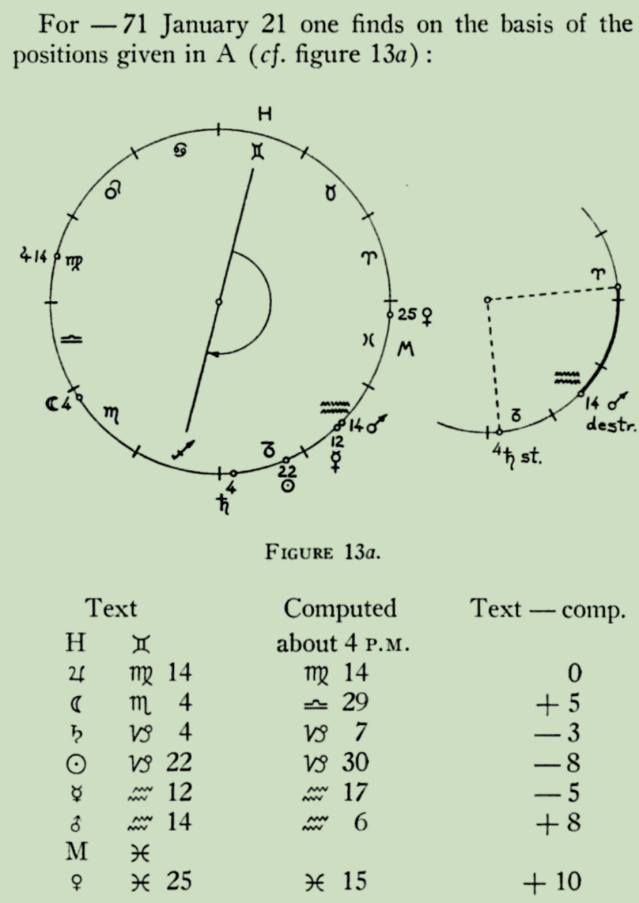
L-71: Neugebaur and Van Hosen present this diagram on page 77.
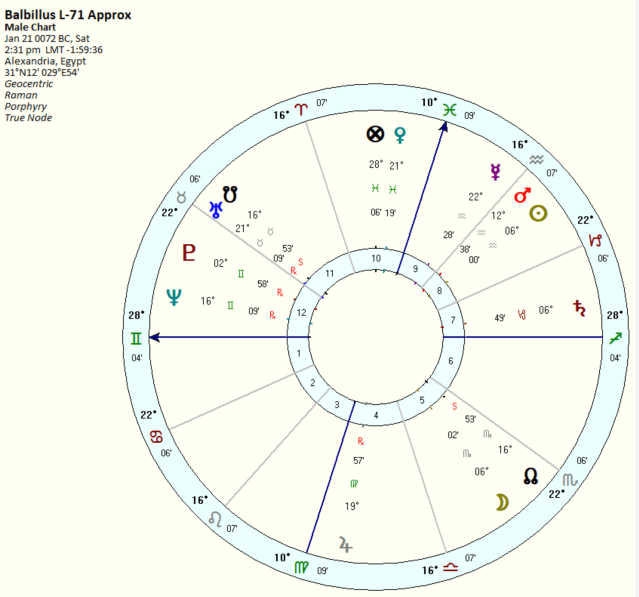
Modern Approximation:
To understand Neugebauer and Van Hosen’s translation of the Babillius text, we need to review some of the vocabulary they use:
Centers (page 3): “The ‘centers’ are the four points which the ecliptic has in common with the horizon and meridian at a given moment.” In other words, the “centers” are the Asc, Dsc, MC, and IC of the chart.
Epanaphora (page 7): “A sign which follows, in the order of the signs of the zodiac, a center. Thus, Taurus is epanaphora if Aries is in Midheaven.” Hellenistic astrologers apparently used epanaphora(ἐπαναφορά) to label the sign that “comes after” or “rises after” an angular sign. For example, in chart L-71, as described by Balbillus, the Sun lies in Capricorn, which is epanaphora with respect to Sagittarius on the western horizon.
According to the translation by Neugebaur and Van Hosen (page 77): “since the luminaries (sun and moon) did not fall in a center, he [the astrologer] went to the epanaphorai, and he did not take the Horoskopos as starter, nor the sun, which was in epanaphora of the setting point, but he took Saturn in Capricorn as starter … because it had the greater claim in the theme and was in his own house. And he says that Mars in Aquarius is the destroyer, and he computed the distance from Aries to Mars, and so long, he said, would be the length of life.”
Balbillus is using a chart that is about a century old as an example. Our modern calculation places the natal sun in Aquarius rather than in Capricorn, which would make the Sun epanaphora and thus unacceptable as a starter. Saturn is angular in Capricorn, and it is dispositor of the Sun, Mars and Mercury. Saturn is the daytime triplicity ruler of the Gemini Ascendant and probably also ruler of the term/bound of the Ascendant degree. Thus, Saturn has “greater claim” in this diurnal theme and can act as the starter.
Unfortunately, the translators, who are not astrologers, state that the length of life is determined by the distance from Aries to Mars, which makes no sense. Had they understood the astrology, they would have understood that the length of life is reflected in the distance from the starter planet Saturn to the destroyer planet Mars. Most likely this distance would have been measured in oblique ascensions (rising times). Consulting the speculum for the modern chart in Janus 6 software, we find the following:
Oblique Ascension of Mars: 296:17 equatorial degrees.
Oblique Ascension of Saturn: 255:18 equatorial degrees.
The difference is about 41 degrees of the celestial equator passing over the horizon as primary motion carries Mars to Saturn—an equatorial arc corresponding to about 41 years of life.
It is not clear from the translation of Balbillus’s text which method he used to measure the arc between Mars and Saturn. Prior to Ptolemy’s Tetrabiblos, the more common method appears to be the use of rising times (oblique ascensions) of the two planets, expressed in equatorial degrees, to measure the arc between them, regardless of whether or not the signs containing the planets were actually rising. In this chart, Mars lies in the sign Aquarius, whose rising time is 25 equatorial degrees, and Saturn occupies the sign Capricorn, whose rising time is 31 equatorial degrees.
If we use the values of the original positions in the Babillius chart, Mars at 14 Aquarius is about halfway (47%) through the sign Aquarius and would have traveled 11.7 degrees of R.A. through this sign.
Saturn at 4 Capricorn is about 87% of the way from the end of the sign, so Mars would need to travel about 26.9 equatorial degrees to reach Saturn, or about 26.9 years. The sum, 11.7 + 26.9 = 38.6 years of life expectancy, is calculated by rising times in the original figure presented by Balbillus. Calculating the primary direction of Saturn, the starter, to Mars, the destroyer, at the Naibod rate, by either the method of Ptolemy/Placidus or Regiomontanus, yields a lifespan of about 41 years.
Because Neugebaur and Van Hosen are not astrologers and don’t understand what Balbillus is saying, they inaccurately state that the length of life is calculated by the arc between the position of Mars (14 Aquarius according to Balbillus) and the square aspect of the starter Saturn (whose position is at 4 Capricorn and whose squares are at 4 Aries and 4 Libra). The translators then, without understanding, measure the ecliptic arc from 14 Aquarius to 4 Aries and claim that the length of life must be 50 years, thereby misleading the reader. Instead, Balbillus would have measured the equatorial arc, in oblique ascension, between Saturn and Mars to estimate the length of life.
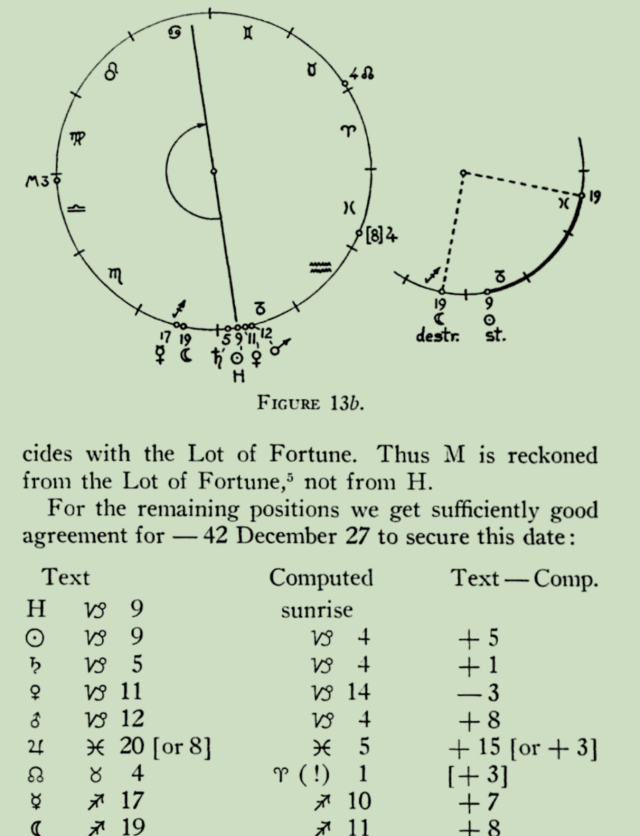
Now let’s consider the other chart, L-42, discussed by Babillius. Here is how Neugebaur and Van Hosen present it on page 78:
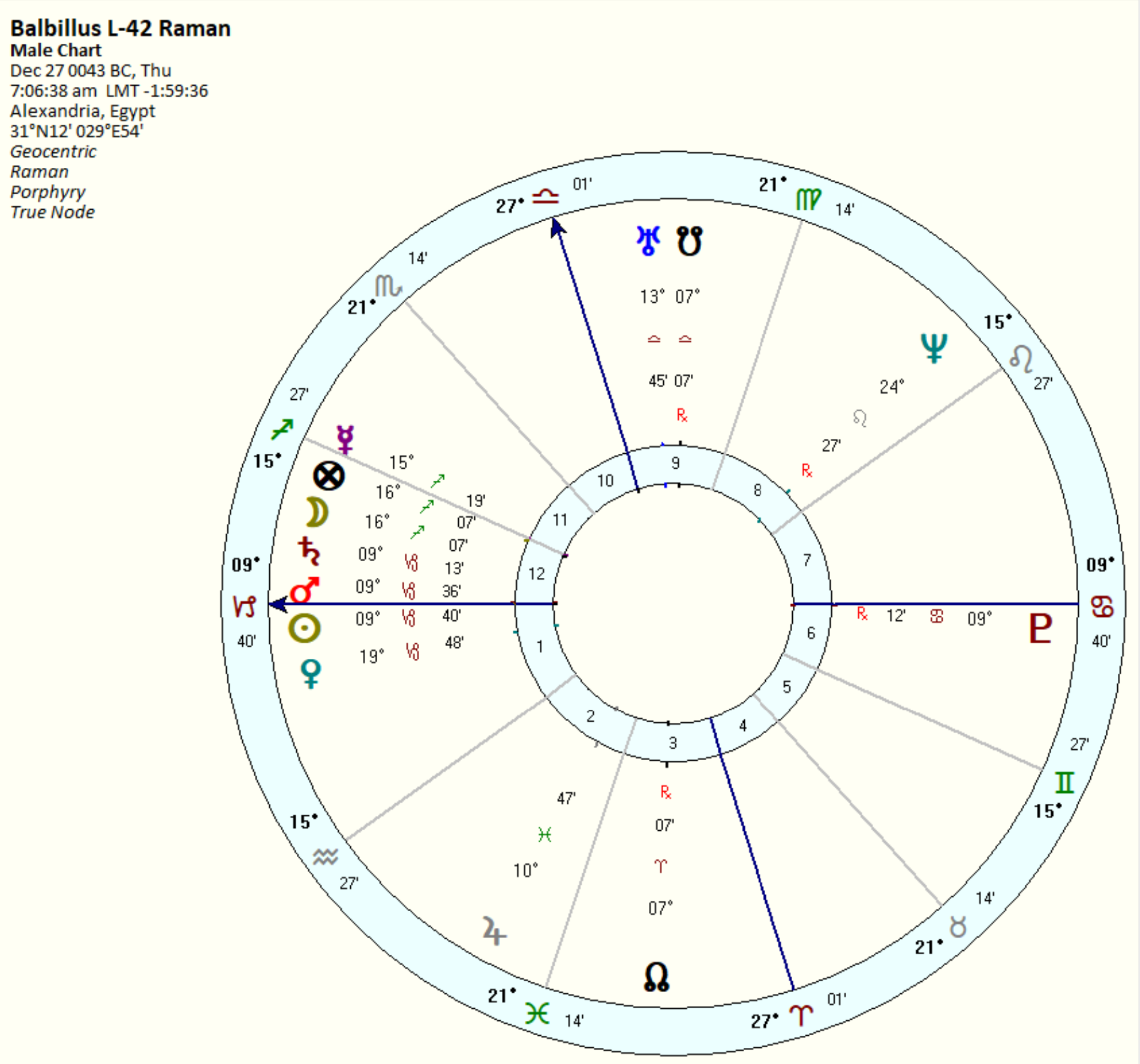
This is a modern estimation of the same chart:
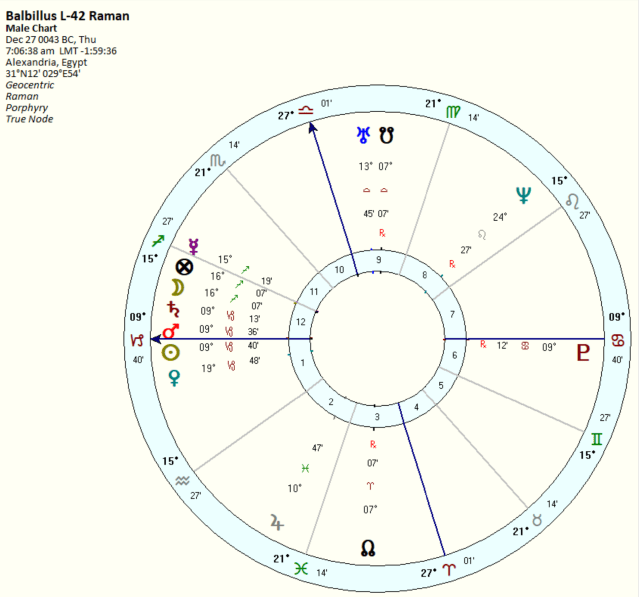
In the modern version, the positions of the planets are slightly different from those given by Balbillus. In addition, the MC lies in 27 Libra as opposed to 3 degrees of Libra in the original text. Neugebaur and Van Hosen suggest that the original chart shows the MC calculated from the Part of Fortune, not from the Ascendant degree. In fact, 3 Libra is on the Midheaven when 19 Sagittarius (the degree of the Moon in the original chart) is rising.
The Sun is on the Ascendant in this nativity, and Balbillus takes the Sun to be the “starter.” To determine the destroyer, “one comes to the destructive sign, which is the one rising before the starter, i.e., Sagittarius. And finding there the Moon (in 19 Sagittarius), he says that it becomes the destroyer. Taking the orbit of the Sun up to the quartile of the degree of the Moon (at 19 Sagittarius), i.e., Pisces 19, then, he says, comes the destruction. In other words, the Moon in the 12th sign from the Ascendant and in aversion to the Ascendant is a destructive planet, and its sinister square aspect into 19 Pisces becomes the destroyer. By primary motion, 19 Pisces will rise to the Sun on the Ascendant, thus indicating the end of life.
Again, we can estimate the length of this native life based on oblique ascensions:
The rising time of Capricorn is about 31 degrees of R.A. in this chart. It will take the destroyer about 21 years to go from the end of Capricorn to the Sun.
The rising time of Aquarius is about 25 degrees of R.A. in this chart. This corresponds to 25 years.
The rising time of Pisces is about 21 degrees of R.A. in this chart. 19 Pisces will take about 13.3 years to rise to 0 Pisces.
Adding 21 + 25 + 13.3 = 59.3 years as the estimated length of life of this native by the method of rising times.