
When I was a boy, before our family had a television, I used to enjoy the radio program The Shadow, whose main character Lamont Cranston used his hypnotic power to cloud men’s minds so they cannot see him. The program opened with the line: “Who knows what evil lurks in the hearts of men? The Shadow knows!“

Fast forward to July of 2026 and the Podcast Shadow Work | The Lila Astrology Podcast
featuring the co-founders of Lia Labs, Steven Forrest, Ricky Williams, and Linnea Miron, discussing shadow work.
Shadow work, as described in the conversation, is the process of recognizing and integrating the parts of yourself you’ve hidden or denied due to shame, conditioning, or fear. It requires deep honesty and cannot be approached as a quick fix, because the shadow often carries powerful, potentially destructive material that demands humility and sustained reflection. Astrology—especially markers like the South Node—can help identify where these unconscious patterns originate. Although the work is internal, relationships often expose shadow dynamics, making trust and non‑judgmental communication essential for growth.
In his comments, Steven Forrest recounted the historical shift in the use of the “N-word” in U.S. culture. In the 1980s and 90s it was acceptable and effective to say the N-word aloud to confront, expose, and ridicule racism in America. He noted that the cultural environment has changed regarding what we can or cannot explicitly talk about, using the N-word as an example.
A friend of mine from a foreign country contacted me asking for an explaination why so many young astrolgers were freaking out about Steven’s use of the N-work to illustrate the historical cultural shift. Non-judgmental communication seemed to have vanished from the astrological community and been replaced by angry condemnation. What had Steven done that seemed to these outraged astrologers like an unpardonable mortal sin, worthy of burning in Hell for eternity? If this were the age of the Inquisition, human nature being what it is, would his critics have burned Steven at the stake?
In response to my friend’s request, I watched the relevant section of the broadcast and did not find it offensive. Steven was merely describing historically a cultural shift in the use of the N-word, which he had experienced in his lifetime. He was not advocating its use, but merely recounting a historical period during which it was culturally acceptable to say the N-word out loud to counter racism.
A comparison might be Mark Twain’s novel The Adventures of Huckleberry Finn in which Twain uses the racial slur 219 times. The book is set in the 1840s along the Mississippi River to mirror the real language, social attitudes, and deep-seated racism of that era. Twain’s intent was to document and expose racism, calling attention to the deep collective shadow of racism in America. My impression on viewing the Podcast was that Steven’s discussion of the historical and cultural changes in the use of the N-word in the U.S.A. had a similar purpose.
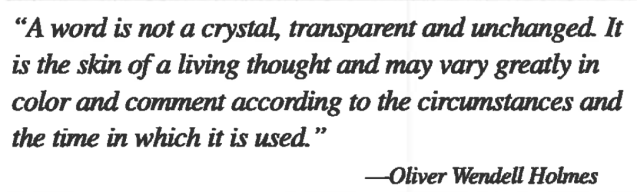
Randall Kennedy, writing about the use of the N-word in the scholarly Journal of Blacks in Higher Education quotes jurist Roger Traynor that “the meaning of particular words varies with the verbal context and surrounding circumstances and purposes in view of the linguistic education and experiences of their users and their hearers or readers.” He also quotes Oliver Wendell Holmes:
Reading the many hyperbolic statements of outrage that Steven could utter the forbidden N-word left me withthe impression that Steven had inadvertently connected his viewers with their own shadows.
Various astrologers’s comments of outrage appear to reflect classic shadow projection. Instead of examining their own discomfort with the history and meaning of the often harmful N-word, they attributed all impurity to the speaker, presenting themselves as morally superior beings. Their moral absolutism appears to function as a defense, preserving a sense of personal righteousness while avoiding the messy realities of racism and collective historical trauma. By reacting to the N-word in isolation rather than the context in which it was uttered, they deny the collective shadow and sidestep deeper self‑reflection. This kind of outrage replaces nuanced engagement with reflexive condemnation, revealing an unwillingness to tolerate psychological complexity. If Queen Gertrude of Shakepeare’s play Hamlet had read these extreme reactions, she might have commented, “The lady doth protest too much, methinks.”
Jesus probably described such extreme indignation best in the Gospel of Matthew 7:3-5 King James Version:
3 And why beholdest thou the mote that is in thy brother’s eye, but considerest not the beam that is in thine own eye?
4 Or how wilt thou say to thy brother, Let me pull out the mote out of thine eye; and, behold, a beam is in thine own eye?
5 Thou hypocrite, first cast out the beam out of thine own eye; and then shalt thou see clearly to cast out the mote out of thy brother’s eye.