
The Anthology of Vettius Valens consists of ten volumes describing the practive of Hellenistic astrology, with case examples. It was written roughly between 150 and 175 CE. Valens was born in what is now Antakya, Turkey, and traveled widely in seach of astrological knowledge from teachers familiar with Babylonian, Greek, and Egpytian traditions. He experimented with various astrological techniques to determine their reliability and published his own findings about what worked in practice.
Some current astrologers believe that Valens used his own birth chart in parts of the Anthology to illustrate astrological concepts. For example, Chris Brennan, in his Astrology Podcast (#372, October 2022) suggested that the chart for 8 February 0120 CE with Virgo rising, Mars in the 1st house, Sun in 22 Aquarius and Moon in 7 Scorpio is actually that of Valens himself. However, the source notes at astro.com point out that “the Sun at 18° Aquarius and the Moon at 1° Scorpio in this chart are not consistent with the data given by Valens in his sample chart (Sun 22°, Moon 7°).”
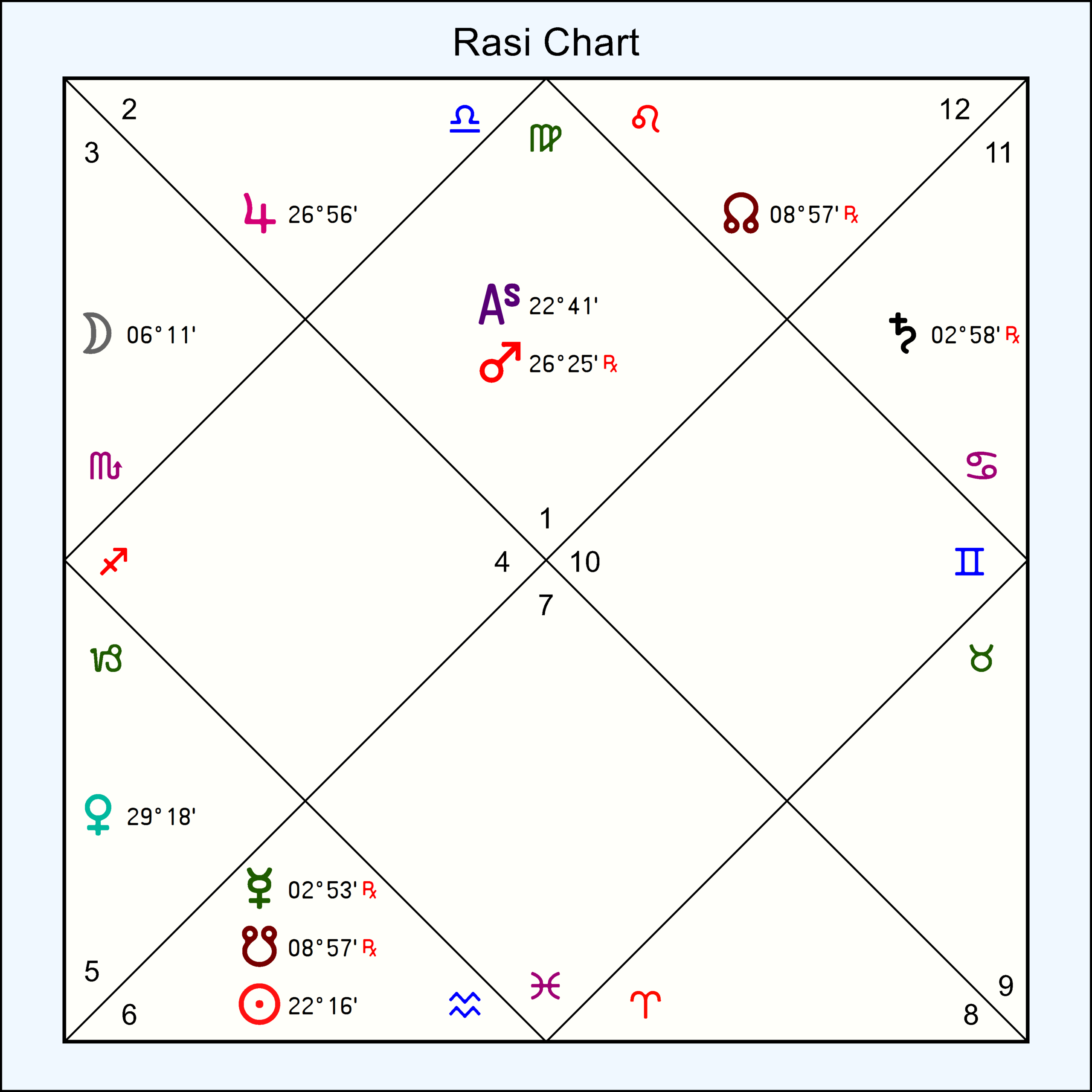
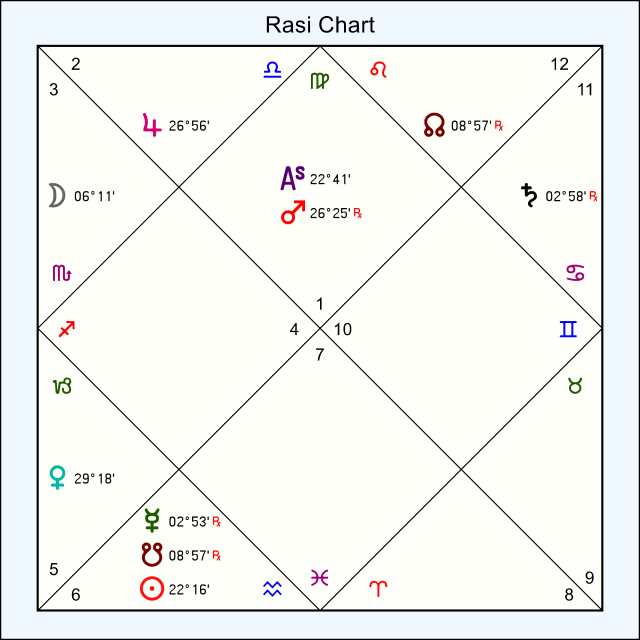
This discrepancy is easily accounted for because the chart at astro.com is calculated in the tropical zodiac, but Valens used a sidereal zodiac, which is most consistent with the modern Raman ayanamsa. If we calcualte the speculative Valens birthchart for a birth time of 8 pm LMT at Antakya, Turkey, 8 February 0120 CE, with Raman’s ayanamsa, we get the following chart:
In Book IV, Section 11, of the Anthology (Riley trans.), Valens writes, “We, however, traversed many lands /163P/ and came to Egypt, where we fell in with avaricious teachers.” He goes on to describe the “Operative Year” and his “Method of Fractions,” in which he uses this speculative chart of his birth as an example:
“Let us start our exposition from this point: when investigating the current year of a nativity, we divide by 12. Count the remainder from a star that is able <to transmit> to a star that is able to receive. In this way we will discover what sign the year transmits. What I have said is easy to comprehend but complicated to determine, since all the stars, plus the Ascendant, the sun, and the moon, can transmit to and receive from each other. /165P/”
“Let us take an example so that we may make an intelligent beginning: sun, Mercury in Aquarius, moon in Scorpio, Saturn in Cancer, Jupiter in Libra, Venus in Capricorn, Mars and the Ascendant in Virgo. We are investigating the 35th year [age 34]. I divide <35> by 12 for a result of 24, remainder 11. We note which stars are separated by 11 signs: we find 11 signs from the Ascendant and Mars <in Virgo> to Saturn in Cancer; additionally, 11 signs from the moon <in Scorpio> to Mars, or from Venus <in Capricorn> to the moon. All of these transmissions are effective in the 35th year. Whatever predictive force each star has, it will predict appropriately, good or bad, in the transmissions that we have outlined in the preceding discussion.”
Note how the planetary positions described by Valens match those in Brennan’s speculative birth chart for Valens. Here, Valens is discussing the annual profections at age 34, his 35th year of life, which is an 11th whole sign from the Ascendant (Capricorn in this chart) profection year. Because he is in his 35th year, he divides 35 by 12 and finds his profection year to be 35/12 = 2 with a remainder of 11. In other words 35 = 12 + 12 + 11, or two complete 12-sign cycles plus 11 signs counted from the Ascendant as the 1st sign.
Valens goes on to explain his use and delineation of “transmissions”:
“Whenever there are many transmissions, it is necessary to take into account whether benefics or malefics predominate. Award the prize to whichever group does predominate. If neither does, the year should be judged as varied and changeable.
To find the overall influence in any nativity, it will be necessary to count the years from the sun, the moon, and the Ascendant, and, if the count ends at an empty place, then they <sun moon Ascendant> will be transmitting to the rulers of these <empty> signs. These three figures have great influence, whether the transmission is to benefics, to malefics, to the angles or operative places, or to places not at the angles. Next it will be necessary to investigate the transmissions of the other stars: if malefics control the year, but the three aphetas have a benefic effect, then the year will be vigorous and distinguished, after some doubt, anxiety, and annoyance. If no star transmits to another, and if the distribution is to empty places, then it is necessary to note the empty places: especially if any stars are there in transit, they will receive the distribution. It is also necessary to count from the Lot of Fortune, from Daimon, from Love, and from Necessity, for it is from these points that the critical illnesses, benefactions, and dangers are apprehended. /175K/ …”
Valens appears to be referring back to a comment he made in Section 7 of Book IV: “Each star is located in the zodiacal circle according to its house <place>. In a similar way, each star becomes associated with another by its configuration at the nativity.” Valens is pointing out that each planet in the nativity lies in a certain house, as measured with respect to the natal Ascendant. In a similar way, each planet occupies a sign that can be viewed as the “first house” of that planet, and the other planets will occupy a particular house (whole sign) position with respect to the natal position of the planet under consideration.
In this chart, we would expect age 34, his 35th year, to be a difficult period. By annual profection, the profected Ascendant is Cancer, and the Lord of the Year (profectional ruler) is the Moon. In the birth chart, the Moon lies in the 3rd house in Scorpio, the sign of its fall. Counting 11 signs from the Moon, taking Scorpio as the 1st house with respect to the Moon, we arrive at the Ascendant in Virgo, which contains Mars, the malefic of sect in this nocturnal chart. Counting the 11th place from Mars, starting with Mars in the natal 1st house, we arrive at the contrary-to-sect malefic Saturn Rx in Cancer, its detriment. Thus, both malefics are highly activated at age 34 by the method of transmissions and fractions of the operative year. If this is the birth chart of Vettius Valens, he must have had a very difficult 35th year of life. In Section 7, Valens notes that “Saturn, Mars, and the moon indicate that the native will live dangerously abroad on land and sea, wandering or living in alien climes.”
In an Astrology Podcast, Chris Brennan notes that Velens, in Book 7, apparently uses his own birth chart to identify a dangerous time in his life when he was 34 or 35 years old. Valens compares his own chart with those of five other people who were on the same ship with him and shows how the astrological events in all of their charts aligns at the time when they were caught in a storm and shipwrecked.
The predictive technique of using “transmissions” during “operative years” with the “method of fractions” does not appear to be widely used by contemporary astrologers. It has many nuances, which Valens details in Book IV of his Anthology. A spanish-language video by Mako de Dionisio, introducing the technique, can be found at Transmisiones: La técnica helenística para predecir tu año
Addendum: reading over the quotes from Valens, I realized that his thinking may not be immediately obvious, so I prepared the following summary of my understanding of what Valens is suggesting:
Summary:
The Method of Fractions is a predictive technique that Valens describes in his Anthology in the 2nd century CE. It is used to determine to which sign (“place” or “house”) a given year of a person’s life “transmits” its influence to, helping the astrologer identify the focus and quality of that specific year. Valens introduces this technique in the context of the “Operative Year.” To use it, you must first determine the current year of the native’s life, expressed in ordinal number form (age plus 1).
- Divide by 12: Take the current year of life in its ordinal form (e.g., age 34 = 35th year) and divide it by 12.
- Find the Remainder: The remainder is the key. For a 35th year, 35/12 = 2 with a remainder of 11.
- Count the Transmissions: You then count that remainder (in this case, 11) from the starting point—such as the Ascendant or the sign containing the Sun, the Moon, or individual planets—to see which sign or planet they “transmit” to.
Valens explains that this creates a web of activation:
- Activation: The method identifies which planets are “activated” in a given year. If you find 11 signs from the Ascendant to a planet, that planet becomes highly influential for that year.
- Effective Transmissions: If a planet transmits to another planet, the predictive force of that receiving planet (its natural significations, whether beneficial or malefic) is activated for the native during that year.
- Judging the Year: If many transmissions land on benefics, the year is generally good. If they land on malefics, it may be a year of hardship, danger, or anxiety. If the transmissions lead to “empty places” (whole signs with no planets), Valens suggests looking to the ruler of that sign to see what it promises.
The Method of Fractions is deeply interconnected with Annual Profections. By using the remainder of the year to count from the Ascendant or other significators, Valens was essentially creating a way to “cross-reference” the annual profectional ruler with other planets in the chart.
In his own life, Valens used this to show how a specific, dangerous period (his 35th year) was corroborated by multiple transmissions landing on difficult placements, reflecting his experience of being shipwrecked.